Comparison of Grayscale and Binary Image Representations for Balinese Script Classification Using EfficientNetV2
DOI:
https://doi.org/10.70103/galaksi.v3i2.132Keywords:
Balinese Script; Efficientnetv2; Transfer Learning; Image Classification; Image RepresentationAbstract
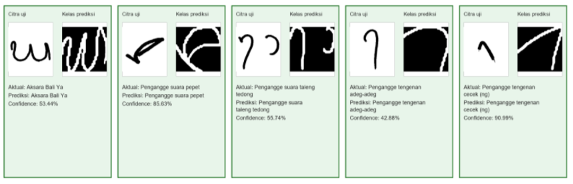
Balinese script is a cultural heritage whose preservation increasingly depends on digital technology, yet automatic recognition of its characters remains difficult because many glyphs share similar strokes. This study compares two image representations, grayscale and binary, as input for classifying 28 classes of Balinese script consisting of eighteen basic characters (wreastra), six pengangge suara and four pengangge tengenan. A dataset of 1,337 images was resized to 224x224 pixels and augmented into 8,022 images, then classified using EfficientNetV2B0 with transfer learning, a batch size of 32, a learning rate of 0.001, a dropout rate of 0.3 and 30 epochs followed by fine tuning of the last thirty layers. Robustness was also examined through three hold-out splitting ratios of 80:10:10, 70:15:15 and 60:20:20, which produced accuracies of 90.55%, 89.55% and 88.81%. The grayscale representation reached a test accuracy of 91.92% with a macro F1-score of 92.11%, slightly higher than the binary representation with 91.67% and 91.78%. Deployment on new handwritten images revealed a domain gap that lowered recognition performance, indicating that data diversity is more decisive than the choice of representation.
Downloads
Published
How to Cite
Issue
Section
License
Copyright (c) 2026 I Made Dwi Putra Asana, I Komang Anom Widya Pratama, Putu Surya Wedra Lesmana, Made Leo Radhitya

This work is licensed under a Creative Commons Attribution-NonCommercial-ShareAlike 4.0 International License.